Tuesday, August 7, 2018

Final Course Reflection


Coming into this course, I was very skeptical of how it was going to go. Overall, it was an interesting experience. While I am not a gamer, I do see the benefits of what this kind of class can offer students who do find joy in gaming. There have been times throughout this course that I was introduced to many new ideas. Digital Citizenship, while I was aware of the idea, was something I never thought was important for my students. Many of the topics we covered were like this for me. However, this course has shown me that students today have a different set of problems than what we had when I was their age. Today’s students are faced with so many more problems that are not even happening in their physical school. Flipped and Blended Learning are thing I never thought possible or effective. However, I certainly have gained new knowledge on these topics that change this. It will allow me more time in the classroom, because students will be able to learn more without me being right there in front of them.

For the future, I know that I will see thoughts presented in this class on a daily basis. I now have many resources to consult when adding technology into my classroom. I will be sure that when adding this technology that it is not just for the sake of adding it. Rather, the technology should have a purpose and be meaningful to the content. I also now know that I will have to stay ahead of the game. My students are growing up in a world that technology is always being presented to them. While I may not be too far behind, I need to make sure that I stay up to date with trends and what is intriguing to my students. Technology will always be a game changer for my students’ school life outside of the school house. They will be able to interact this content in my class, even when they are not face to face with me. I would love to implement more global awareness to my students in the world of music. I think it is extremely important for them to see what is happening outside of just their own community.

Overall, this class was much more intriguing than I initially thought. While I still have a ways to go in understanding the effects of gamification in the classroom (as I think many do), I do feel more comfortable trying it out, now that I have been through it myself. There are so many opportunities here for music students that I did not realize before.

Monday, August 6, 2018

Real or Fake?

Before reading the second blog post, revealing which things to be real and which to be fake, I made my own assumptions just by their surface. I feel as though we do this often in today's society. We sometimes indirectly teach our students to do the same things. However after reading the rationales, there are much more to these than I first thought.

The picture with the airplane used science I did not even think of to determine its authenticity. I initially just used my common knowledge on flight regulations to know that the plane was entirely too close to those buildings. This really takes some critical thinking that I could definitely use in my classroom. Sometimes when we look at a piece of music, we just see what is on the surface, but if we dig deep, we may find other crucial moments that we had once overlooked.

In the hotel reviews, I certainly thought that the first one had to be fake. The detail about the trip had nothing to do with the hotel, and to me, that is the purpose of the review. However, the blogger determined that they were both real upon further investigation. The lesson I learned here is that not everyone will respond the way you would to a prompt or review, everyone has their own way of expressing their feelings. This is an important idea to translate into our classrooms as well. Each students is going to interpret the material you give them in different ways and respond in different ways as well. This does not make one student more right over another.

Steve Reich's Clapping Music

I first discovered Steve Reich's Clapping Music a few years ago in my undergrad. Reich composed his work "Clapping Music," so that no instruments were needed. The only thing needed are the players clapping hands. This work is particularly challenging because it requires perfect analysis of rhythm. The rhythm changes gradually and suddenly, keeping the players on their toes, no pun intended.

Image result for steve reich clapping music app
The entire purpose of the app is to improve the rhythm of oneself. I find this very useful in the classroom and I create a competition out of it, especially in my percussion section. While this is not a multi player game, it does produce your score at the end, if you make it that far. A great way to get your kids involved is to have them report their score each week. Write these scores on the board and let the game begin. Because this game is so challenging, you will most definitely see different students taking the lead at different times. If you are finding that your students are discouraged because they cannot make it to the end, start with scoring just the first few phrases rather than the entire piece.

Once the students have mastered a majority of the piece on their own, introduce the actual score to them. A portion is shown below:


Image result for steve reich clapping music score

Now that your students have an idea of what each rhythm is like on its own, put them to the test. Can they play along with their classmates? Start with a metronome and go from there. 


From this example, you can see that even creating competitions with two or three students could be quite fun. Keep in mind that this is extremely difficult, so start slow and let them work their way up to a comfortable tempo.

References:

Deneuville, T. (2015, July 10). Clapping Music App: Get Your Reich On. Retrieved from https://www.icareifyoulisten.com/2015/07/clapping-music-app-reich/

Steve reich Clapping music score | Chamber Music Ideas | Pinterest | Steve reich, Music score and Piano sheet music. (n.d.). Retrieved from https://www.pinterest.co.uk/pin/396176098447572591/

Sunday, August 5, 2018

Sugata Mitra's hole in the wall TED Talk

The idea of the fashion in which or school systems operate is out of date, is a topic that is long over due in daily discussion. Our school systems operate on a notion of school is a factory. In today's society, this is far from what it should be. Our world is no longer supporting a society full of laborers. Rather, we are a world of entrepreneurs. The problem is that no one learns how to become one. Sugata speaks about students being faced with something they do not know how to do, and eventually, just figure it out.

I disagree with him in saying that this is where schooling should be headed. Students today are facing a lack of precious time. With an ever changing economy and social turmoil, there is an ever increasing need for success, quick success. Students absolutely need teachers in the classroom guiding them in the right direction. Should there be a bigger focus on critical thinking, absolutely, but to abandon the student to learn for them self is a dangerous game. While the students he studied were using language that was a decade ahead of their time, the question is, did they understand how to apply their knowledge. To read a script is one thing, but to understand it is what matters.

Maker Revolution

Previous to viewing this quest, I had never really heard of this movement, but it is quite inspirational. In today's world, we forget how easy it is to create, design, and market products. Also, I had not realized how effective this could be in the classroom. As teachers, we know that the more hands on an assignment is, the more our students are likely to take away from the lesson. In music classrooms, we are always playing different instruments, but we never really discover how and why these instruments work the way they do. The easiest way to demonstrate this idea in a music classroom is with percussion instruments.


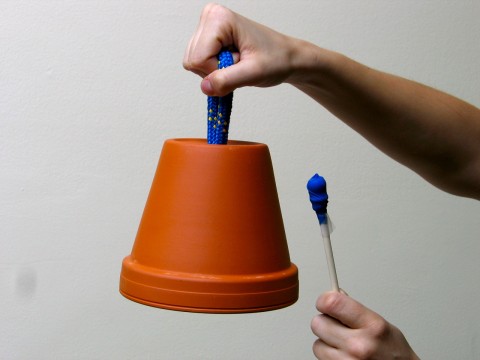
homemade musical instrments pot bell

Pictured above is a homemade bell. This would be a great project to use inside of a music classroom. This is a great way to teach students how the shape and size of an instrument can effect how it sounds. Striking larger flower pots is going to produce a deeper sound, while smaller pots are going to produce a higher pitch. Also, students could create hypotheses about their project. Does shape effect the sound of the pot? Does what the pot is made of effect the sound?

These are great ways to get the students engaged and even spark an interest in them for being makers. These students could invent musical instruments that have yet to be used in the world. 

Reference:

S., Gardener, G., Cummins, S. T., & Ettinger, B. W. (2018, January 16). Splendidly Creative {and simple} Homemade Instruments! Retrieved from https://www.howweelearn.com/spectacular-homemade-musical-instruments/

Wednesday, July 25, 2018

Blended, Flipped, or Personalized?

It is extremely difficult for music educators, specifically ones that teach performing ensembles, to imagine teaching in any other format than what has been done for centuries. Our situation is a bit different in these settings because we are always dealing with a performance task. Most of the activities or assessments in our classrooms are performance based. 99 times out of 100, we are going to be rehearsing with 60 or more students on a piece of music. There is not some magical app or website out there that has help on how to play the pieces right in front of our students. So, it is scary for many music educators to even think about changing it up.


Personalized Learning Design Elements

After going through this course, I have began to think of ways I could possibly incorporate these styles of learning in my performing arts classroom. While I do not see it as functional on a daily basis, I do see some of them becoming useful from time to time. These would like surface or be relevant during sectional work. This is a period of time that the students gather in their particular section and work on smaller portions of a piece or pieces. Here I could see blended or personalized learning coming into play. I could see students gathering around a laptop or iPad and watching short master classes on a concept that is presented in their music.


Image result for blended learning

Similarly, I could see flipped learning introduced for home assignment purposes. There could be instructional videos presented by professionals in the field that teach them a subject that I may not have time for in class. These could be considered sub-mini lessons outside of regular class time. Almost like a science lab that is attached to those science classes we took in undergrad, remember those? While this is not complete implementation of these learning devices, I think it is a way to incorporate them into our unique situation.

Image Reference:

Blended Learning. (n.d.). Retrieved from https://michiganross.umich.edu/programs/executive-education/why-ross/blended-learning

Personalized Learning. (2018, March 21). Retrieved from http://www.dreambox.com/personalized-learning

Final Course Reflection

Coming into this course, I was very skeptical of how it was going to go. Overall, it was an interesting experience. While...